


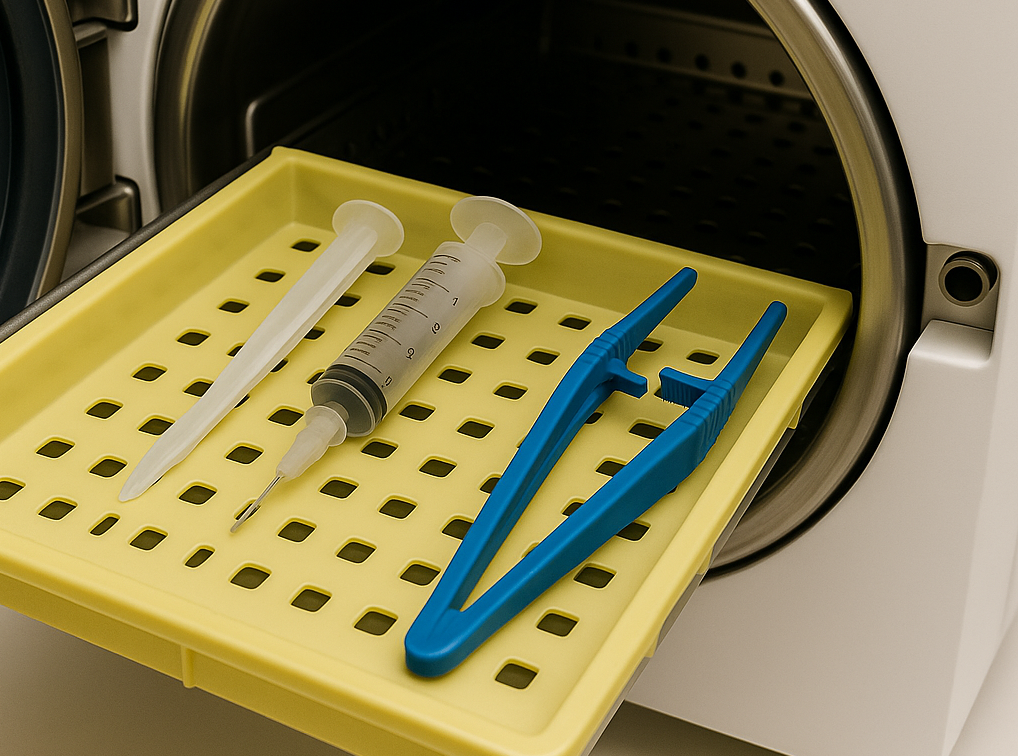
Best Plastics for Autoclaved Medical Devices
Autoclaving is the benchmark for sterilizing reusable medical devices. But not all plastics are up to the task. Between 121–134°C of saturated steam and repeated pressure cycles, only select high-performance materials maintain their strength, shape, and biocompatibility over time.
This guide breaks down the most reliable plastics for autoclaved medical devices, compares their properties, and outlines design considerations for optimal performance and regulatory alignment.
Content Summary
-
Autoclaving is tough: Only select plastics can survive repeated 121–134°C steam sterilization.
-
Top performers: PEEK, PPSU, and Ultem (PEI) handle 500–1000+ cycles with minimal degradation.
-
Avoid: PVC, PS, and polycarbonate—they deform or crack after a few cycles.
-
Success = material + design: Hydrolysis resistance, uniform geometry, and stress-free molding extend part life.
-
Regulatory ready: Use ISO 10993 and USP Class VI medical-grade polymers.
-
Future trend: 3D-printable and recyclable autoclavable plastics are enabling faster, sustainable development.
What Is an Autoclave?
An autoclave is a sterilization system that uses pressurized saturated steam, typically at 121–134°C (250–273°F), to kill bacteria, viruses, fungi, and spores on medical instruments, laboratory equipment, and industrial components.
Unlike chemical sterilization, autoclaves rely on a combination of:
-
High temperature
-
High pressure
-
Moisture penetration
This makes steam sterilization extremely effective, but also harsh on many plastics and polymers that cannot withstand repeated thermal and moisture exposure.
Why Some Plastics Fail Under Autoclave Conditions
Many commonly used plastics like polyethylene (PE), polyvinyl chloride (PVC), and polystyrene (PS) simply can’t handle repeated exposure to heat and moisture:
-
Hydrolysis degrades polymers like polycarbonate (PC) after as few as 10 cycles.
-
Softening or warping occurs when materials have glass transition or melt temperatures too close to 121°C.
-
Stress cracking and discoloration develop in low-grade or inadequately processed materials.
These materials might work for gamma or EtO sterilization, but not steam.
What Makes a Plastic Autoclave-Ready?
Autoclave-compatible plastics must offer:
-
High heat tolerance: Melt points or glass transition temperatures well above 134°C.
-
Hydrolysis resistance: Polymers must not degrade when saturated with hot water vapor.
-
Dimensional stability: Retain form, tolerances, and strength through many heat/cool cycles.
-
Mechanical durability: Withstand hundreds of sterilizations without brittleness or loss of function.
-
Regulatory readiness: Must meet ISO 10993 or USP Class VI for biocompatibility in medical applications.
Top Plastics for Repeated Autoclaving in Medical Devices
The following materials have demonstrated durability across repeated steam sterilization cycles and are widely used in surgical, diagnostic, and therapeutic tools.
Note: Lifespan depends on design geometry, stress concentrations, and autoclave parameters.
| Plastic | Autoclave Lifespan | Key Properties | Common Applications |
|---|---|---|---|
| PEEK | 1000+ cycles | Exceptional heat and chemical resistance; maintains integrity | Surgical tools, reusable implant guides, orthopedic instruments |
| PPSU | 1000+ cycles | High impact strength, hydrolysis-proof, color-stable | Sterilization trays, surgical handles, reusable housings |
| Ultem® (PEI) | 500–2000 cycles | Rigid, dimensionally stable, high dielectric strength | Enclosures, rigid scopes, lighting housings |
| PSU / PES | ~500 cycles | Transparent, stiff, anneals with heat cycles | Reusable fluid connectors, IV components |
| Polypropylene (PP) | ~200 cycles | Low cost, moderate heat tolerance | Labware, limited-use trays, syringe parts |
| Acetal (POM) | ~300–400 cycles | Low friction, rigid, precise tolerances | Surgical gears, clamps, internal fixtures |
| PTFE / Fluoropolymers | Virtually unlimited | Non-stick, chemically inert | Seals, tubing, coatings, endoscopic liners |
Is This Plastic Autoclavable? (Quick Compatibility Table)
| Plastic | Autoclavable? | Practical Answer for Searchers |
|---|---|---|
| Polycarbonate (PC) | ❌ No | Degrades by hydrolysis, becomes brittle and cloudy after ~10–20 cycles |
| PVC | ❌ No | Softens under heat, can release additives |
| Polystyrene (PS) | ❌ No | Warps below autoclave temperatures |
| Polypropylene (PP) | ⚠️ Limited | Can survive ~100–200 cycles depending on grade |
| Polyethylene (HDPE / LDPE) | ❌ No | Melting point too low |
| Nylon (PA) | ⚠️ Limited | Absorbs moisture, dimensional changes |
| PET / PETG | ❌ No | Deforms under steam |
| PTFE (Teflon) | ✅ Yes | Chemically inert, unlimited cycles |
| PEEK | ✅ Yes | 1000+ cycles, medical-grade |
| PPSU | ✅ Yes | 1000+ cycles, impact resistant |
| Ultem (PEI) | ✅ Yes | 500–2000 cycles |
| PSU / PES | ✅ Yes (moderate) | ~500 cycles |
| Acetal (POM) | ⚠️ Limited | ~300–400 cycles |
| HDPE | ❌ No | Softens well below 121°C |
Material Selection Tips for Autoclave Performance
1. Match Cycle Expectations to Material Class
-
Premium applications: PEEK, PPSU, Ultem offer longevity for 500–1000+ cycles.
-
Mid-range use: PSU, PP, and POM suit products requiring 50–300 cycles.
-
Single or limited-use: Consider whether lower-cost materials align with clinical and economic goals.
2. Design to Avoid Stress and Moisture Traps
-
Use uniform wall thickness and avoid internal sharp corners.
-
Consider annealing to relieve stress in molded parts.
-
Leverage thermal welding or mechanical fasteners for robust assemblies.
3. Ensure Regulatory and Biocompatibility Compliance
-
Verify ISO 10993 or USP Class VI certifications.
-
Confirm compatibility with all intended sterilization methods: PEEK, PPSU, and Ultem are gamma- and steam-compatible; polycarbonate is not.
Innovation Spotlight: 3D-Printed Autoclavable Plastics
Emerging research has shown that with specialty filaments and modified print settings, certain nylon copolymers can be 3D printed for autoclave-safe parts, opening doors for:
-
Rapid prototyping of sterilizable jigs
-
Low-volume production of PPE or component housings
-
Clinical evaluation of design iterations prior to mold investment
This offers a valuable bridge between early R&D and full-scale production using materials like PPSU or Ultem.
Sustainable Design Through Reusability
Autoclavable plastics support the shift from disposable to reusable device strategies, aligning with both environmental and cost-efficiency goals.
medDesigning with longevity in mind:
-
Reduces waste
-
Lowers per-use cost over time
-
Helps medical facilities meet sustainability targets without compromising patient safety
Partnering for Performance
Injection molding of high-performance autoclavable plastics requires precision tooling, optimized gate placement, and deep experience with material behavior.
Aberdeen Technologies specializes in:
-
Tight-tolerance molding for medical-grade PPSU, PEEK, PEI, and more
-
Process development for sterilizable components
-
End-to-end support for FDA-compliant devices
For long-lasting, sterilization-ready components, collaborating with seasoned molding engineers is essential to ensure each part performs flawlessly cycle after cycle.
Final Thoughts
Choosing the right plastic for an autoclaved medical device is about more than temperature ratings. It’s about selecting materials that balance thermal endurance, regulatory compliance, mechanical strength, and cost across the device’s full lifecycle.
By focusing on validated, medical-grade polymers and thoughtful design practices, engineers can create reliable, sterilization-ready components that perform safely and efficiently in demanding clinical environments.
Post a comment